What It Costs
We don't quote a number here because the fault in Potosi tends to be different from what we see closer to Abilene, and the fix follows the fault. Potosi's median year built sits around 2003, three decades newer than the 1963-to-2003 spread across the wider service area. That means fewer of the worn one-piece doors and exposed torsion springs we replace in older neighborhoods, and more circuit boards, plastic drive gears, and rolling-code opener logic boards from the early-to-mid 2000s starting to fail on schedule. A logic board swap costs less than a spring job. A full opener replacement costs more. Until we're on site and looking at the actual unit, we're not going to make up a figure. What we can tell you is that Potosi's median household income, at $113,340, runs well above the $63,683 median across the broader area, and that shows up in the doors themselves - more insulated steel panels, more openers with battery backup, fewer bare torsion setups bolted to the header with no cover.
Can You Do This Yourself
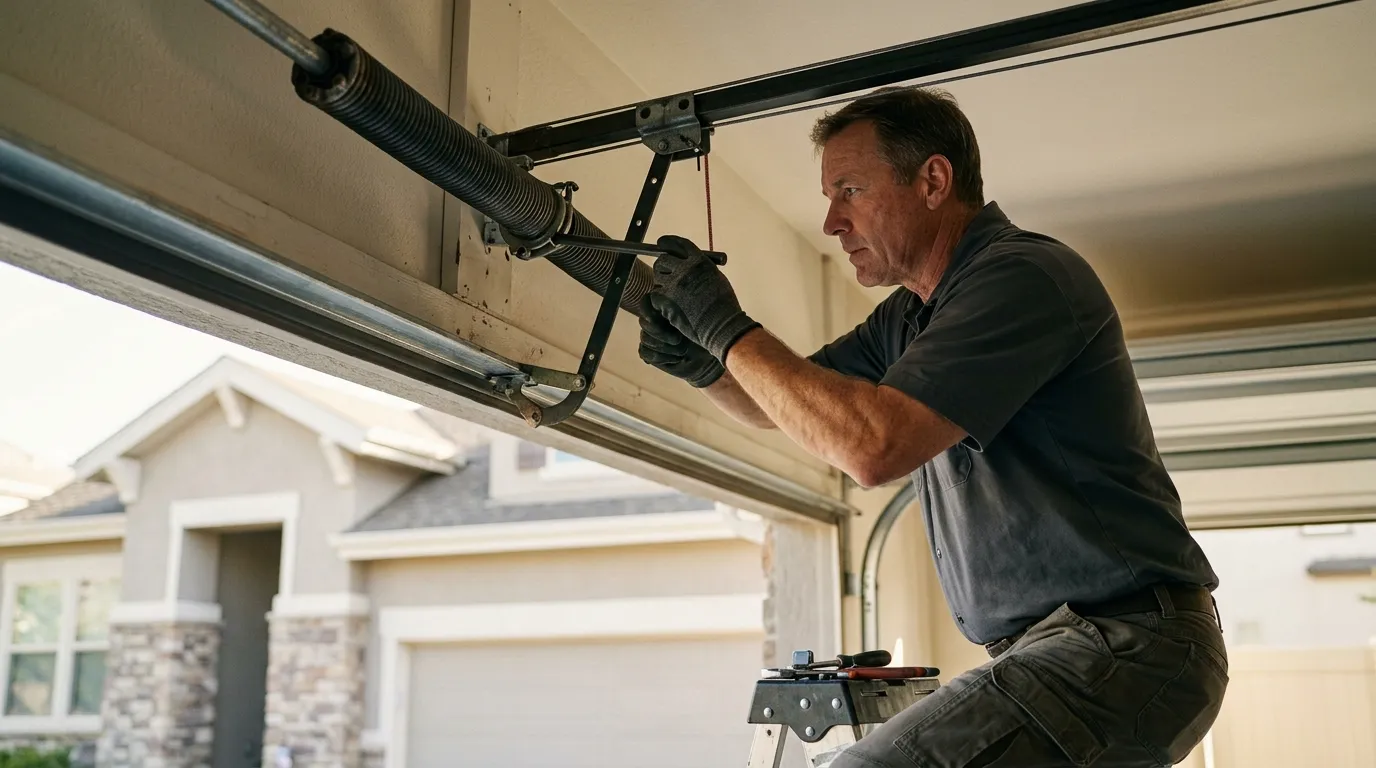
A stuck opener remote or a dead battery in a keypad is worth checking before you call anyone - it takes five minutes and costs nothing. Lubricating rollers and hinges twice a year is also fair game for a homeowner, and worth doing given how much cold-weather cycling these doors see. What we don't recommend touching yourself: torsion springs under load, the opener's logic board, or anything involving the cable drums. On a door from the 2000s the spring is wound tighter for less visible wear than an older heavy door, which makes it easy to misjudge how much force is stored in it. We'll also say plainly that if your opener is original to a 2003 build, replacing the logic board on some models runs close to the cost of a new opener - at that point we'll tell you to replace it rather than nurse along a part that's obsolete anyway.
Why It Happens Here
Potosi's homes cluster tightly around a 2003 median build year, which puts nearly the whole neighborhood's garage doors and openers into the same failure window at close to the same time. That's different from the pattern across much of the rest of the service area, where houses went up anywhere from 1963 to 2003 and doors fail in a scattered, staggered way. Here, when one opener's nylon gear goes, the neighbor's is often close behind on the same clock. The area's cold, moderate climate adds its own wear - freeze-thaw cycling on weatherstripping and bottom seals, and steel panels that contract enough in a hard freeze to change how a slightly misaligned track behaves. None of that is unique to Potosi's soil or its streets; it's the math of a housing stock built in a tight window now aging in unison.
Parts We Carry
For the opener era common in Potosi, we stock nylon and steel replacement gear kits, standard logic boards for the more common drive systems, and belt and chain sections sized to match rail lengths from that period. For the doors themselves, we carry replacement bottom seals and weatherstripping sized for steel sectional panels, standard roller sets, and torsion springs sized to door weight rather than age - a 2003 door still needs the spring matched to its actual pounds, not a guess based on how old it looks. What we don't keep on the truck are obsolete remote transmitters for opener models that have been discontinued for a decade or more; those sometimes need to be sourced before we can finish a job, and we'll say so rather than stall on site.